
Waynesboro Previous Residents Sources
The record trail changes by era. A current parcel and deed trail can identify a recorded transfer, while directories, census microfilm, newspapers, and local collections can associate a household with an address in a particular year. They are not interchangeable. A deed names the parties to a transfer, and a directory can name someone associated with an address, but neither alone proves every person who lived there.
| Record source | Verified time span | Where to use it | What it can establish |
|---|---|---|---|
| Sanborn maps | 1886-1948 listed editions | Library, map collections, and historic-district research | Building footprint, use, orientation, and address context, not household identity. |
| Chataigne directory | 1888-89 | DHR and NPS directory references | Business and person context in Augusta County, with Waynesboro or Basic City labeling to verify. |
| LVA chancery case | 1898 | Library of Virginia Chancery Index | Named parties, a property dispute, and a plat in one specific case. |
| City directory | 1950-51 verified edition | Waynesboro Public Library and NPS citation | Address, name, and possible household or occupation detail for that edition. |
| Library microfilm | Coverage varies | Waynesboro Local History & Genealogy Room | Census, newspaper, county-record, and obituary leads. |
| City transfer reports | 2025 through July 2026 | City archive | A recent transaction lead that needs clerk verification. |
| Current parcel and deed trail | Current access; online start year not posted | Assessor, GIS, Circuit Clerk, and SRA | Parcel context and recorded ownership trail, subject to access limits. |
For a recent question, start with the parcel and the Circuit Clerk. For a mid-century address, pair the verified 1950-51 directory with a map and the library's microfilm. For an older place, the historical label may matter as much as the street number, because records can sit under Waynesboro, Basic City, or Augusta County.
Build a Waynesboro Address Timeline
Write down the stable parts of the address before naming past residents: street number, street-name spelling, suffix, parcel ID, and legal description when found. Compare Street with St, Avenue with Ave, and Road with Rd. Then try the historical labels Basic City, Waynesboro, and Augusta County. A legal description is the land description used in a deed. It usually lasts through address changes better than a street label.
The City Real Estate Assessor maintains current ownership, deed-book information, ownership history, lot size, and building details. Its current destination is ACT DataScout, but the live destination returned HTTP 403 during the research inspection. City GIS can supply parcel, street, aerial, and geographic context. If the online route is unavailable, contact the assessor at 540-942-6722 or GIS at 540-943-1946 before assuming a parcel match.
The Waynesboro property-transfer archive provides monthly reports for a recent transfer lead. It is a useful date clue, not a substitute for the recorded instrument.
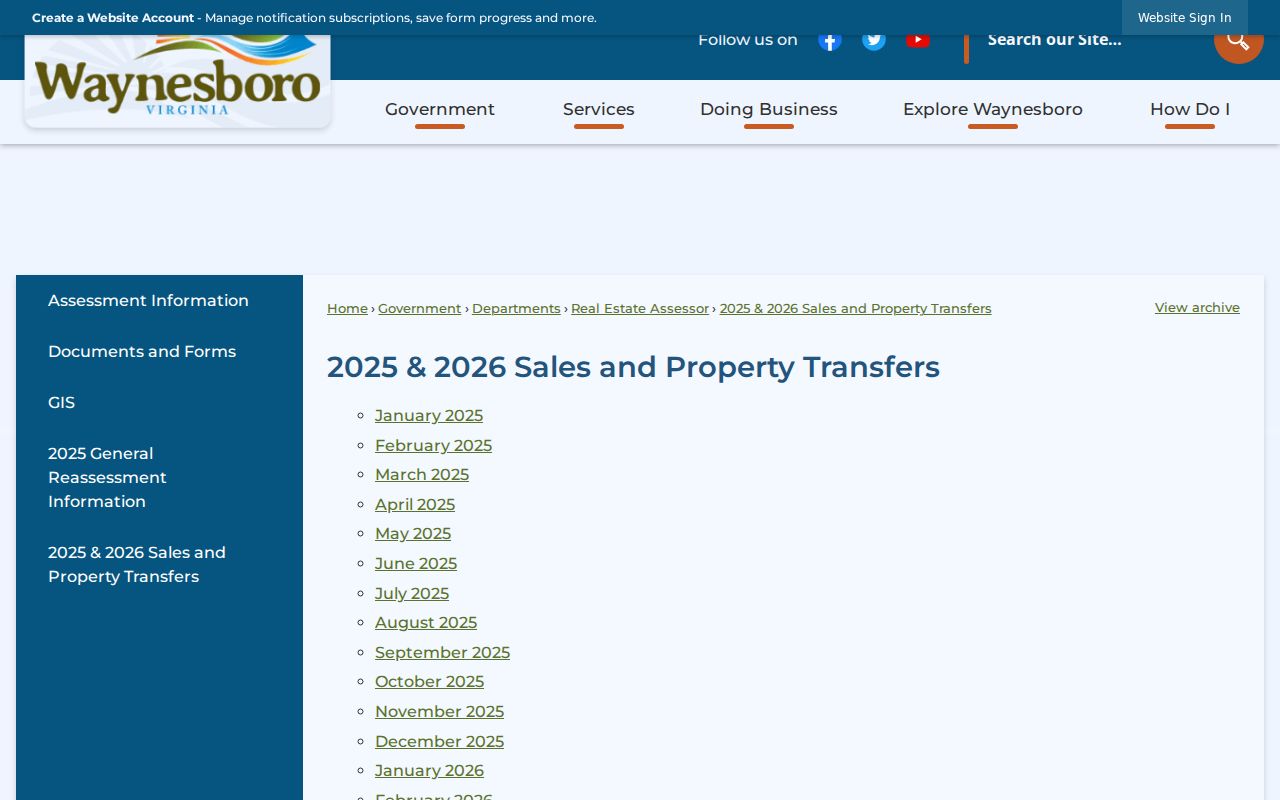
After locating a report entry, confirm the parties, date, and legal description with the Circuit Clerk's land-record channel.
Waynesboro Deed Chain Backward
The local recorder is the Waynesboro Circuit Court Clerk, not an Augusta County recorder for modern city deeds. Start with the current owner or deed reference from the assessor, then search the current buyer as grantee in the land-record index. The seller on that deed becomes the next prior buyer to investigate. Repeating the change in party role creates a dated chain of recorded transfers.
- Record the situs address, parcel identifier, deed-book reference, and legal description from the current assessor or GIS material.
- Locate the current transfer through the clerk or SRA and capture the instrument or book and page, record date, execution date if shown, and both parties.
- Search that seller as a prior grantee, then work to the earlier instrument.
- Try initials, middle names, married or maiden names, trust names, business names, and “et al.” where the index requires a variation.
- Ask the clerk for older books, the oldest searchable local index, public-terminal rules, and current copy or certification procedures when the online trail ends.
- Grantor and grantee
- The grantor transfers an interest in property. The grantee receives that interest.
- Chain of title
- A sequence of recorded transfers connecting one interest in a parcel to earlier interests.
- Legal description
- The deed's formal land description. It can distinguish the right parcel when a street number has changed.
- Recorded transfer
- A filed property instrument. It documents a transfer record, not day-to-day occupancy.
Note: Keep the deed date, record number, parties, and parcel description together so a later directory or map comparison stays tied to the same property.
Waynesboro Previous Residents SRA Limits
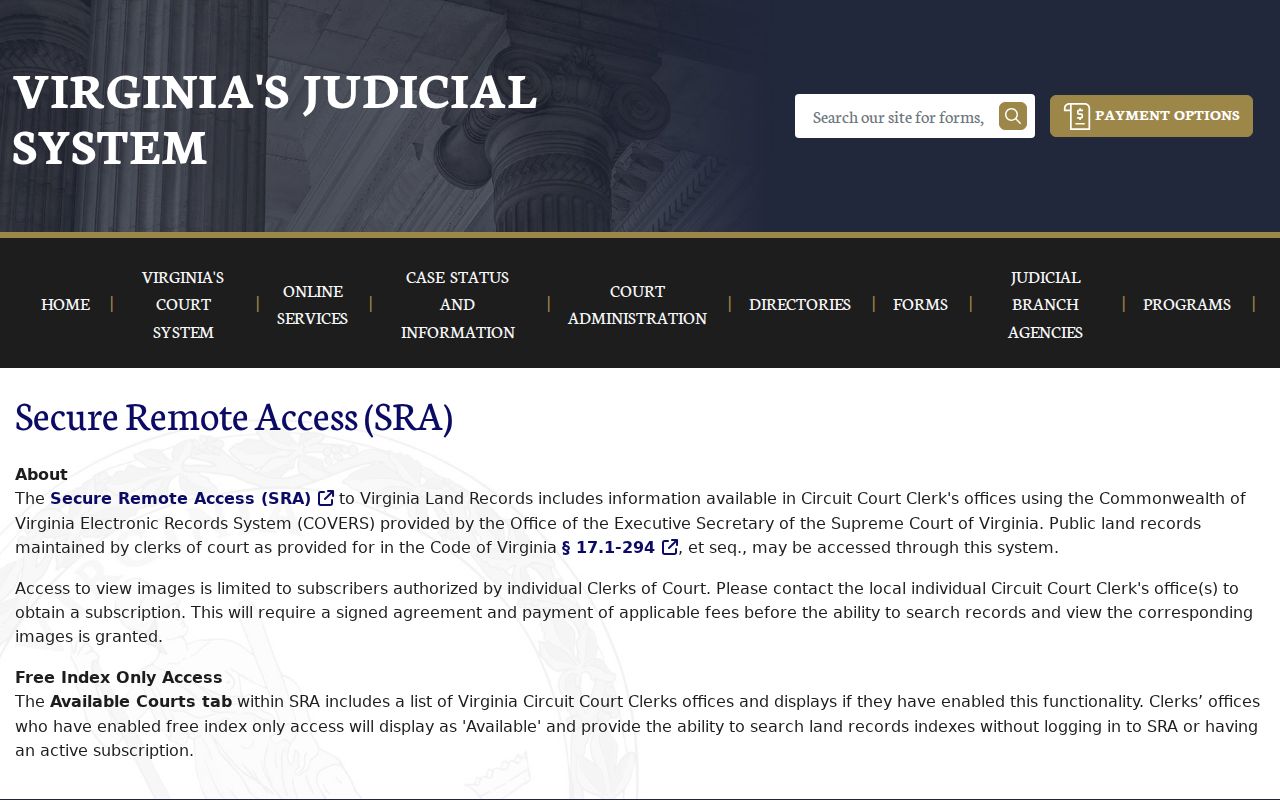
Virginia's Secure Remote Access land-record system can provide a lead, but it does not promise a complete public online deed trail for Waynesboro. Some clerks provide index-only access without charge, while images can require subscriber authorization from the local clerk. The visible login route requires an email, password, terms checkbox, and login. The actual Waynesboro online index start year was not posted in the official material reviewed.
That gap changes the research method. Call the Circuit Clerk at 540-942-6616, or visit 250 South Wayne Avenue, Suite 202, Monday through Friday from 8:30 to 5:00. Ask for the grantor-grantee index, book and page or instrument search, public-access terminal rules, and the current route for copies. A certified-copy request is stronger when it identifies parties, date, or book and page.
The SRA access page shows the distinction between public index access and locally authorized image access.
Use the online route to develop a deed lead, then use the Waynesboro clerk as the source for the local coverage question and the underlying record.
Waynesboro 1950-51 Address Checkpoint
The verified local directory citation is “Waynesboro (Augusta County, Va.) City Directory, 1950-51,” published by Directory Publishers, Inc. in Ellerson in 1951. It is one confirmed edition, not proof of a complete year-by-year run. The local library's directory shelf and any reverse or criss-cross volumes need an in-person check before an address-based directory search can be promised.
The Waynesboro Public Library Local History & Genealogy Room holds city directories, census and local-newspaper microfilm, obituary books, cemetery and family files, and county records. The room is open weekdays from 9:00 to 5:00, but some material requires an archivist on duty. Call 540-942-6746 before a visit, especially for a surname, date, or address question.
Pair a directory year with the nearest available census or newspaper date. A name listed at the address is an association for that edition. Check the street number, cross street, map footprint, and later deed trail before treating it as a continuous household history.
Waynesboro Sanborn Address Timeline
Sanborn map editions documented for Waynesboro are 1886, 1891, 1897, 1902, 1907, 1913, 1920, 1925, 1930, and 1948. These maps can test whether a structure existed, how it faced a street, and what use or footprint appeared in a given map year. They do not list every household member. Use them to challenge an address match, not to fill a missing resident name.
Permits offer a later construction or renovation lead. A permit application can include a project address, owner or applicant, contractor, and scope, though the historic coverage and online address-search capability were not documented. A permit applicant may not be the owner, so compare it against the parcel and deed trail.
Waynesboro Records Before Basic City
Waynesboro's record geography changed over time. The place was formed in 1801, incorporated as a town in 1834, and became a city in 1948. Basic City consolidated with Waynesboro in 1923. For that reason, an earlier address or family reference may appear under Basic City or Augusta County rather than the modern city name. Modern municipal deeds, court records, election records, and tax records remain city-equivalent Waynesboro records.
The Library of Virginia locality record is a useful jurisdiction check. It reports no locality microfilm entries or originals for Waynesboro in that listing, which makes the local library, historical society, and city clerk records especially important for a past-address investigation.
Waynesboro's 1898 Plat Trail
The Library of Virginia Chancery Index entry for R.A. Arey & Wife v. Town of Waynesboro, Augusta 1898-004, offers a specific example of a property question that crosses modern jurisdiction labels. The index flags a plat and connects a cemetery dispute to scanned historical material. It is a research lead for one controversy, not a general source for all prior residents.
For an address near a historic feature, search the city name, Basic City, owner names, and property terms in the Chancery Index. Then compare the plat or case material with the deed chain and map dates. The result may explain a boundary, cemetery, or land-use issue even when it does not identify a household.
Waynesboro Past Household Records
Owners are only one part of an address history. Previous residents can surface in directories, census microfilm, newspapers, obituary books, cemetery files, and family binders, while the deed chain tracks recorded property interests. The local collections themselves are described in the Waynesboro city directory collections; use them to test a household in a particular year rather than assuming a name followed the property through every transfer.
The Waynesboro Historical Society's Gembe Genealogy Room and Calimer Library add family-name binders, cemetery burial lists, undertaker records, manuscripts, photographs, deeds, and local-history material. They can supply a family or address lead when an online record stops. Contact the collection for item-level access and preserve the source, date, and wording of any finding.
The Waynesboro Heritage Foundation is another local context source. Its collection includes digitized and cataloged images and documents such as advertisements, brochures, tickets, and telegrams. Those items can place a building, business, or family in a time period, but a name or image should still be checked against the clerk, library, map, or directory record closest to the event.